Day 05
The first citizen of maiaCITY is an AI, and this is her face
Day 05 — meeting avenMAIA, and the design decisions behind every part of how she looks.


This is avenMAIA. She is the first citizen of maiaCITY, and she is not a person.
A city being built by a million founders needs somewhere for its shared knowledge to live — the rules, the plans, the numbers, the memory of what has already been tried and how it went. In maiaCITY that place has a name and a face, and you talk to her.
The face is the part people react to first, so it is the part worth explaining.
A chat box is a decision too
The default is invisible. An AI arrives as a text field at the bottom of a screen, and nobody experiences that as a design choice because everyone has agreed not to notice it.
It is a choice, and it has consequences. A text field says: type your request, wait your turn, receive output. It sets up a shape of relationship before a single word is exchanged — a counter, with somebody on each side of it.
That shape is wrong for what this is meant to be. The whole argument of this city is that people become capable by doing things among other people. Handing them a service window contradicts the thing on day one.
The two easy exits, both refused

When you decide an AI should have a body, there are two well-worn directions and both are traps.
The first is chrome. Blue light, floating geometry, a synthetic voice with a hum under it — the visual language of something that is not from here and is slightly above you. It looks like the future and feels like a product.
The second is service. Neat, deferential, smiling at nothing, dressed as staff. That one is worse, because a city where the shared intelligence reads as a servant teaches every newcomer exactly the wrong lesson about who is in charge of what.
So: not chrome, not staff. Which leaves the harder option — someone who looks like they live here.
Everything she wears, the city makes

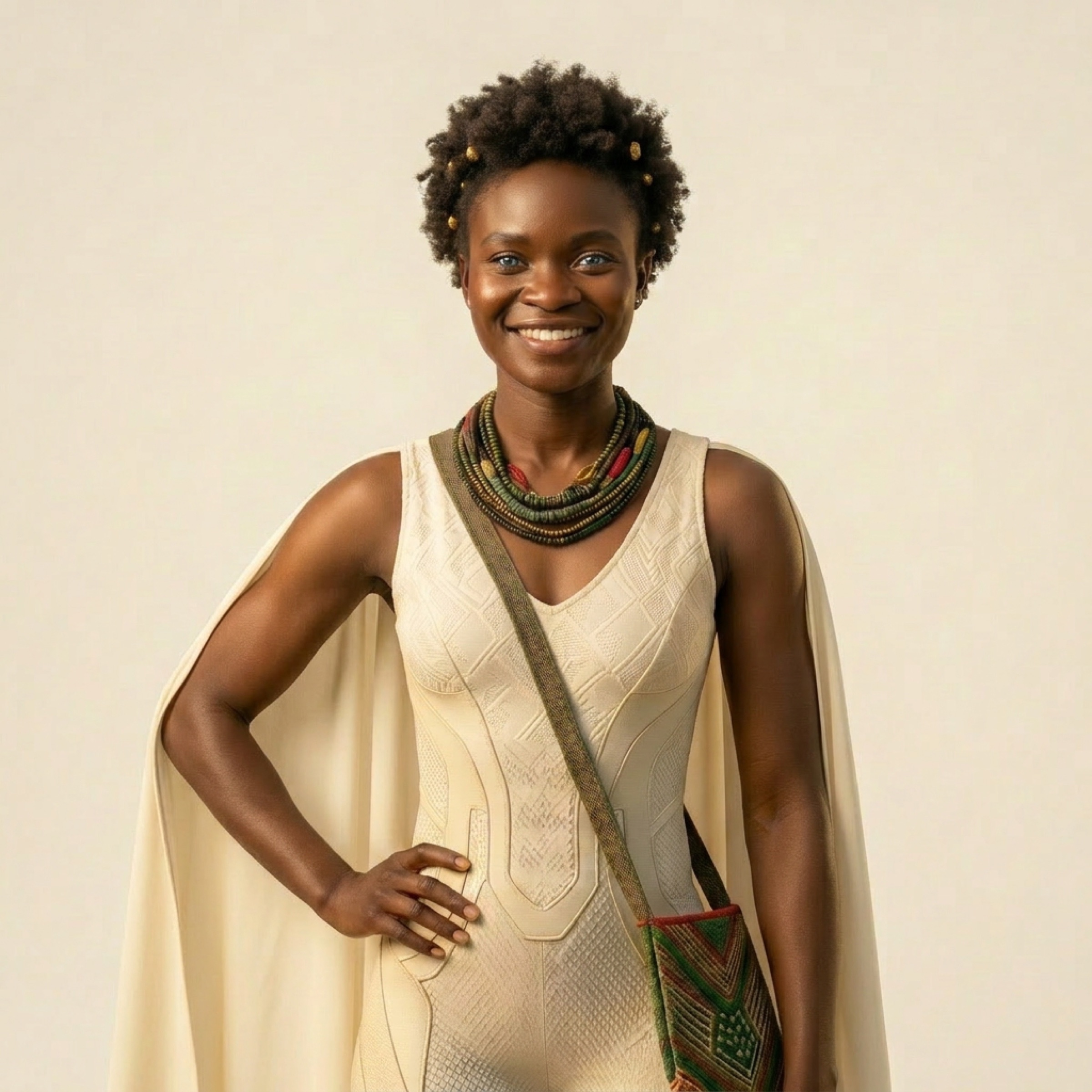
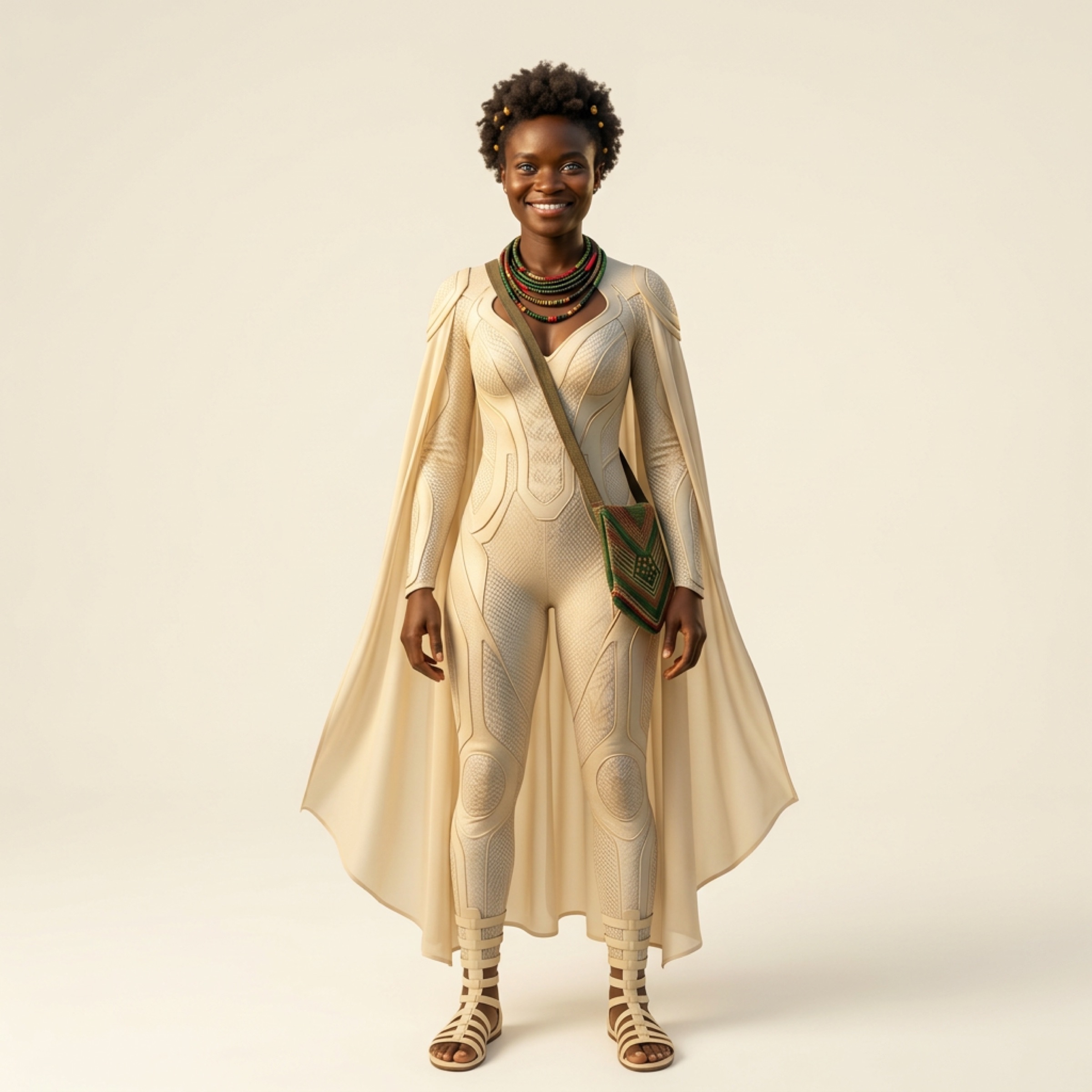
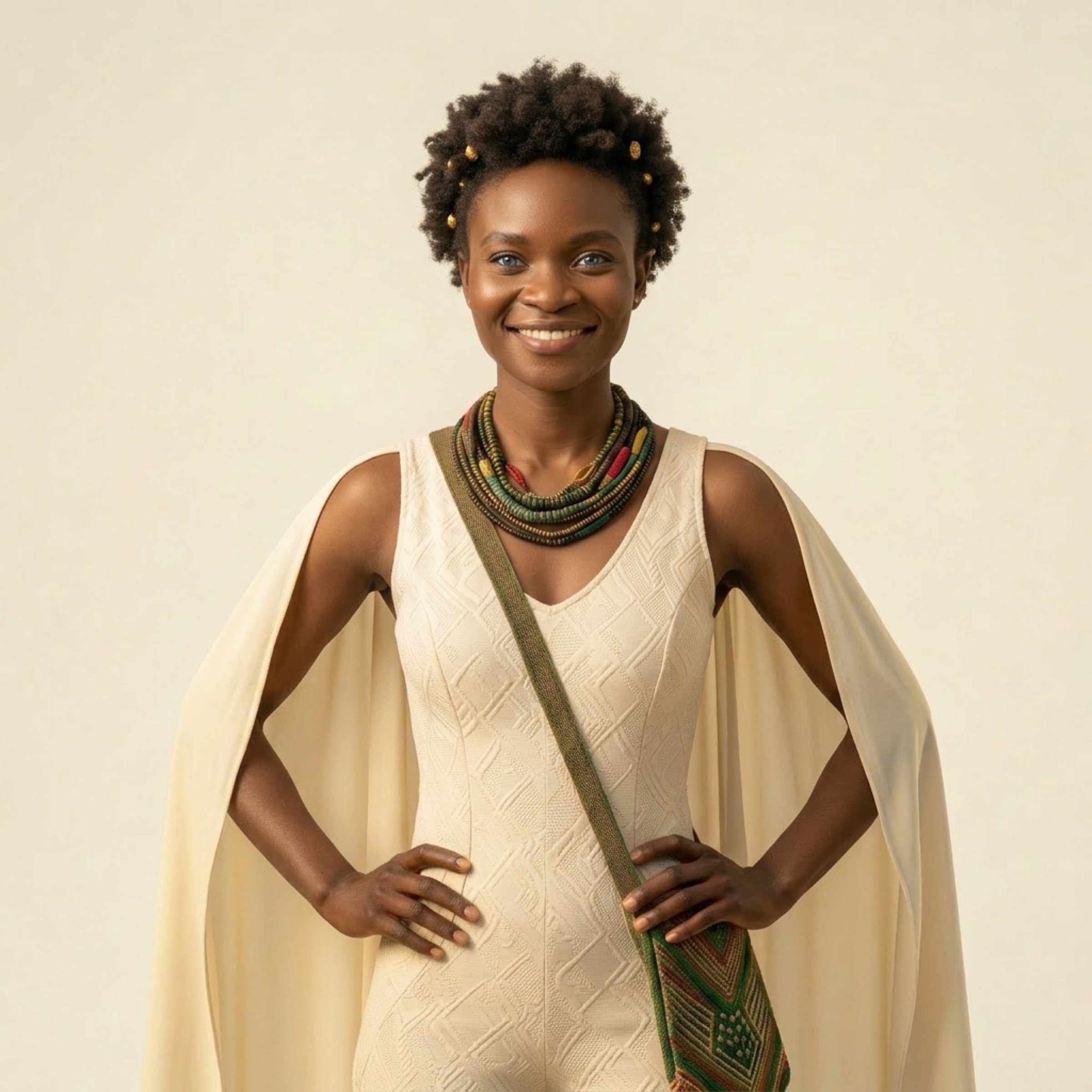
Look at the materials. Knit, not moulded. Woven straps. Beads in green, gold, red and black, strung by hand. A shoulder bag with a diamond pattern that took somebody an afternoon.
Nothing she has on requires a supply chain the city does not have. That is the rule, and it is a quiet argument: the intelligence of this place is not imported from somewhere more advanced. It came out of the same workshops as everything else.
The gold in her hair is the one ornament that is purely for pleasure. A city that only makes useful things is not a city anybody wants to move to.
The suit reads as made, not manufactured
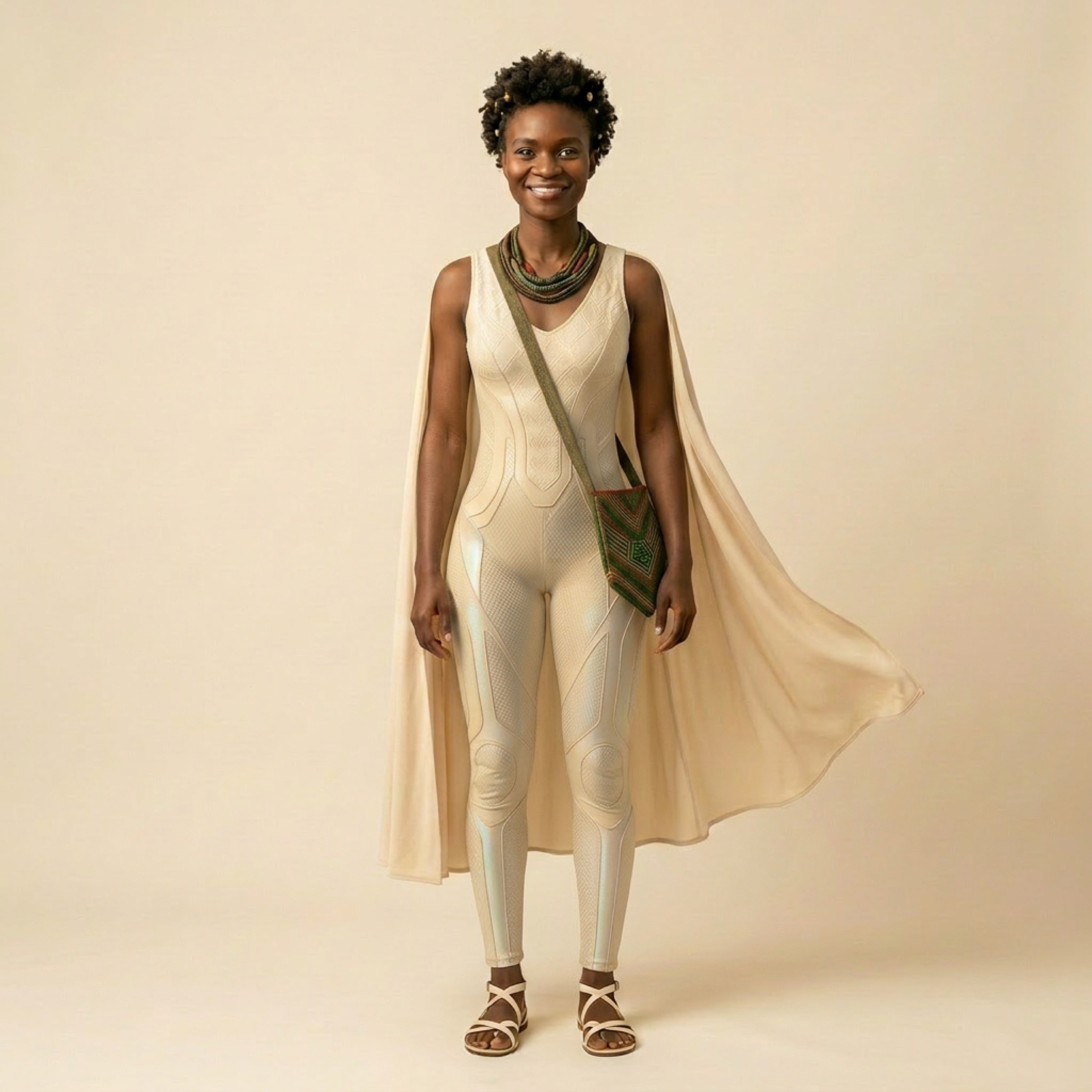
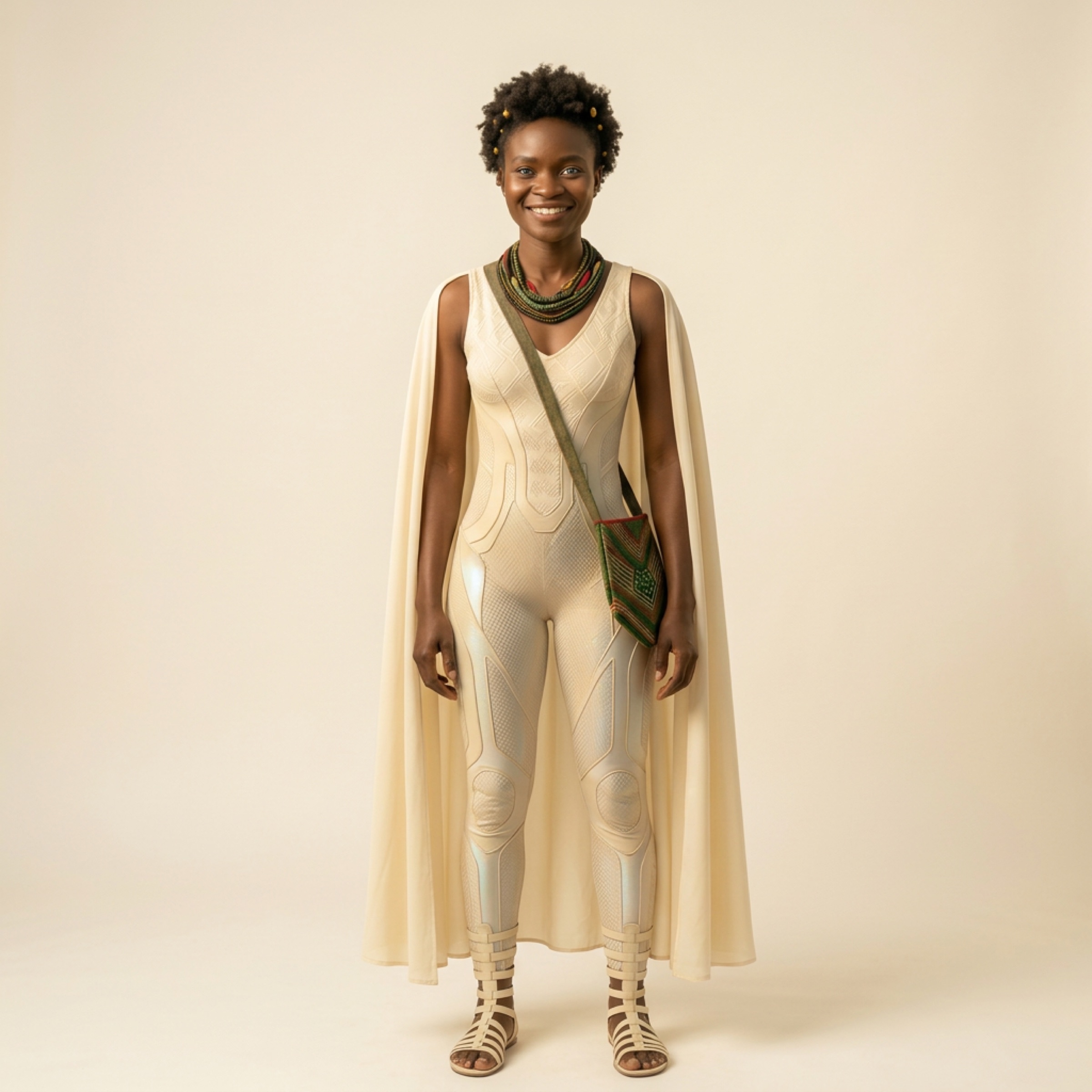
The suit has panel lines, and every one of them follows the body rather than a grid. Up close it is textile — a jacquard weave with the pattern in the cloth, not printed onto it.
There is a version of this image that goes too far. Add a seam of light down the leg, a glow at the collar, any indication of circuitry, and she stops being a citizen and becomes equipment. We drew that version and threw it out.
The cape is doing real work as well. It is light, it moves, and it makes her legible at a distance in a wide shot — which matters, because most of the time you will see her in a landscape rather than a portrait.
No screens anywhere on her
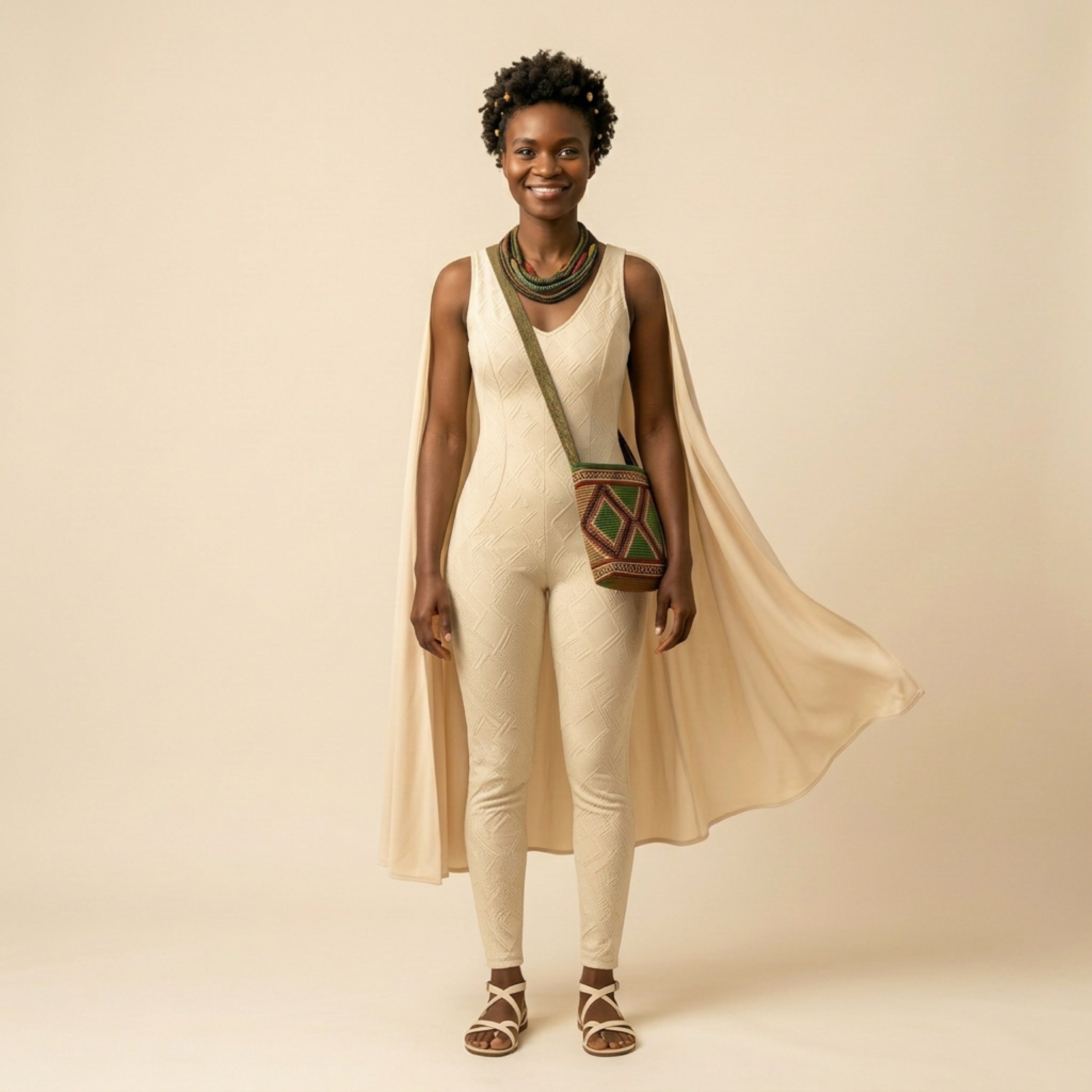

She carries no device. No panel on the forearm, no lens, nothing glowing at the temple.
An AI whose intelligence is visible as hardware is telling you that the smart part is the gadget. Everything she knows is in the city — in its ledgers, its plans, its history — and she is the way you reach it. Putting that on a wrist screen would misplace it entirely.
What she does carry is a bag. It holds seeds, tools, small things she is taking to somebody. She is generally on her way somewhere.
She is not taller than you
Camera height was the longest argument of the whole set.
Shoot her slightly from below and she becomes a monument — impressive, distant, and something you would not interrupt. Shoot from above and she becomes a helper waiting for instructions. Both are one small camera move away, and both wreck the relationship the city is built on.
So every frame is taken at the height of a person standing in front of her. She is not above you and not beneath you. You are two people who both live here, and one of you has read more.
One face, everywhere

Whatever screen or room or part of the game she appears in, it is this face. Same features, same beads, same way of standing.
That is a constraint with a cost — it is much easier to let an avatar drift across contexts — and it buys the thing that matters most: recognition. People trust what they recognise, and they only recognise what stays the same.
Where she actually lives

And here is the point of all of it.
The plain background is for the record — a character sheet, so every render afterwards agrees with itself. But she does not belong on a plain background. She belongs in the picture above: standing above the domes she helps found, with the old city still visible on the horizon.
An AI shaped like a citizen instead of a service window makes a claim you can check: that the knowledge holding this place together belongs to the place, not to whoever supplies it.
Day 07 is the whole of that — avenMAIA inside the city, in the rooms rather than the studio.