Day 03
How a settlement grows from one person to a city block
Day 03 — building maiaCITY in a game first, one hex at a time, until it can carry itself.

One person. One tent, five metres across. One fire.
That is the whole settlement on the first night, and everything in this post is what grows out of it.
We are building maiaCITY in a game before we build it in soil. A game lets you run a settlement forward, watch where it stops working, and start again the same afternoon.
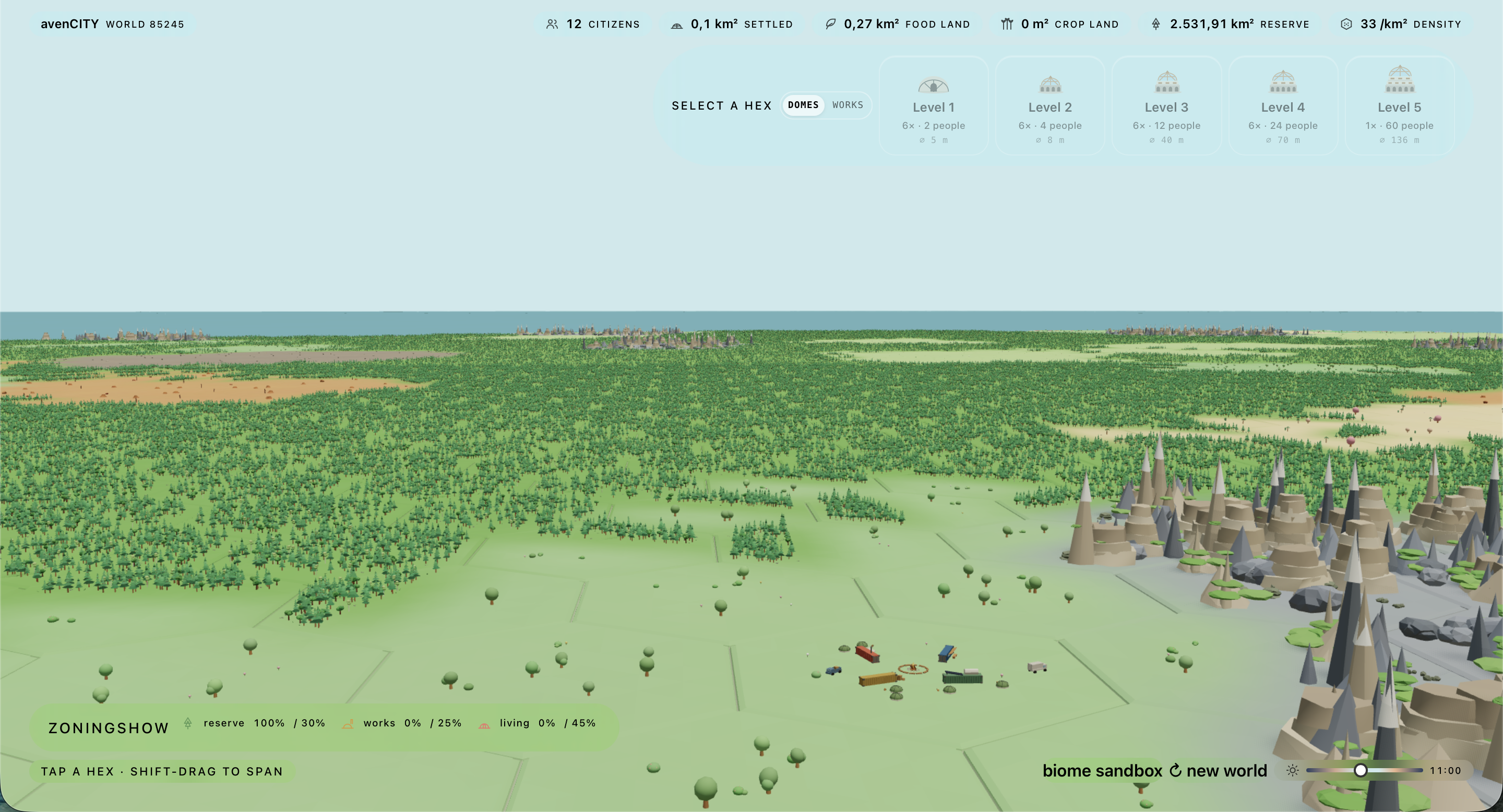
The world is a hex grid, and one hex is the unit we are actually designing. Not the city — the city comes later, and only as copies of this.
Each hex measures 800 metres corner to corner — about 690 metres across the flats — which works out to 415,692 m², or 41.6 hectares of land. Small enough to cross on foot in ten minutes. Large enough to live from.
Self-sufficiency is not a feature you add at the end
A settlement that needs a supply chain to exist is not a settlement; it's a suburb with better marketing. Water, food, power, shelter, work and the people to run it all have to close inside the boundary, or the whole thing is borrowed.
So the hex gets designed as one organism, and it starts from one number per person rather than from a drawing.
1,000 m² of outdoor food forest. 500 m² of growing space under glass. 1,500 m² of green per settler — two thirds of it open to the weather, one third working through winter.
The indoor third is the part people underestimate. Beds under glass, year-round, in the same buildings people live in — that is what lets a northern hex carry its population instead of importing the difference in January.
At 216 settlers the hex owes them 21.6 hectares of food forest and 10.8 hectares of glass. The buildings themselves take another 5: 3.5 hectares of housing domes and 1.5 for the one at the centre.
37.4 hectares of obligations, plus paths, yard and water — which is why the hex is 41.6, and why 216 is the number everything else is sized against.
That ceiling is set before the first tent goes up. Everything that follows is how you get there without breaking it.
Level 1 — one arrives, twelve can stay
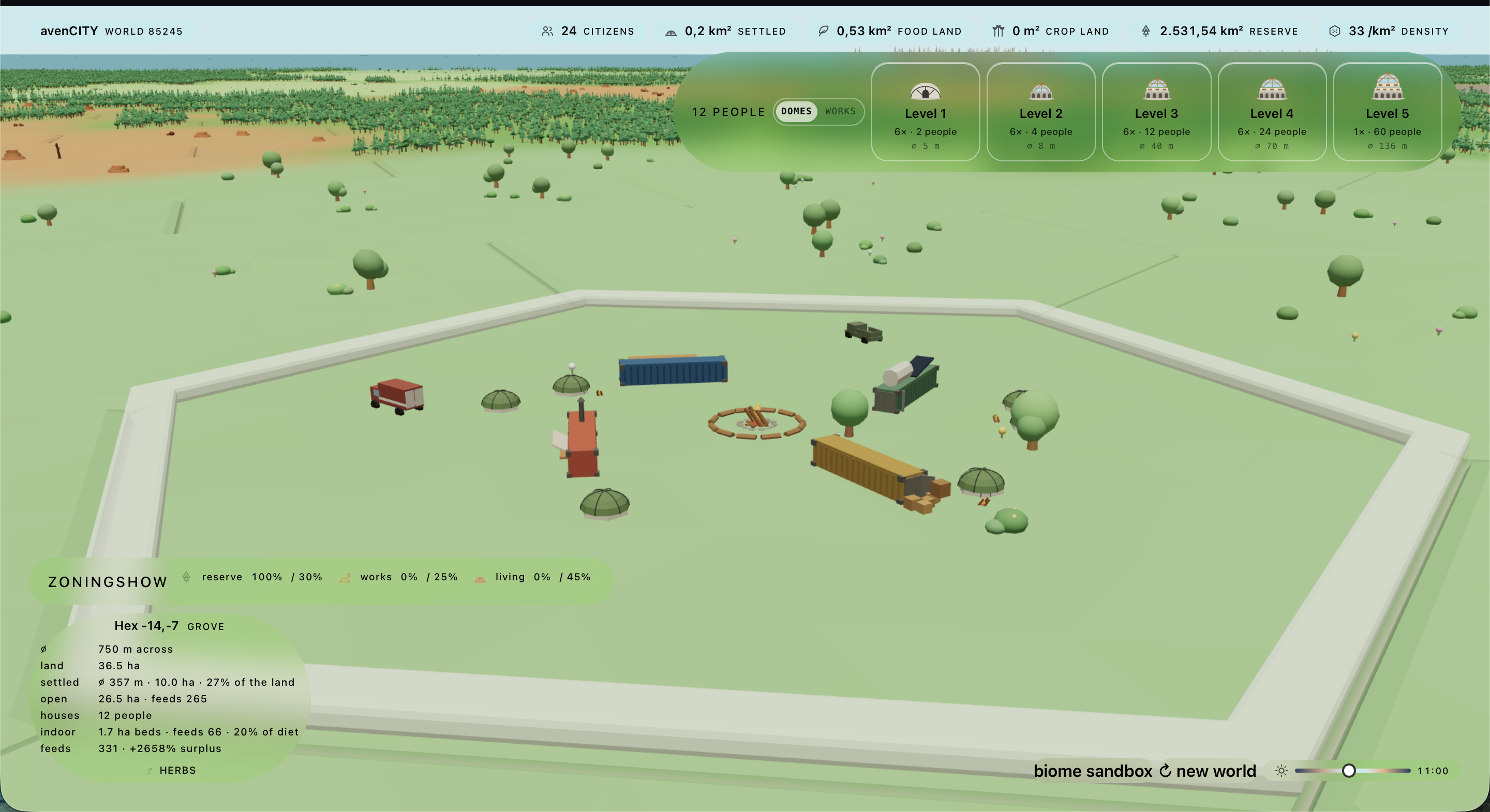
It starts with one human on an empty hex.
One tent, five metres across, for sleeping and nothing else. Then a second, when somebody else turns up. The level tops out at six tents and twelve settlers, and the gap between the first and the twelfth is however long it takes — a season, a year, whatever it takes to convince eleven other people to come and sleep in a field.
Their share of green, at twelve, is 1.2 hectares of food forest and 0.6 under glass — a garden planted in the first season, for the people who will still be here when it's a canopy. The first settler plants it long before there is anyone to eat from it.
Everything else lives in four shipping containers, and those four are the settlement's organs — the same four whether one person is here or twelve:
- Workshop Box — tools, workbench, spare parts, and the machines that build the next level. Nothing gets added to the hex that wasn't made or repaired here first.
- Kitchen Box — the one with the chimney. Cooking, preserving, cold storage; where the food forest turns into meals.
- Sanitary Box — showers, baths, toilets and laundry, with the water tank on the roof. Composting toilets feed the beds, greywater goes back to the trees.
- Energy Box — solar hookup, batteries and inverters, the heat store that runs the hot water and the underfloor loops, and the internet uplink. Power, warmth and connection for the whole camp out of one container.
Four boxes cover work, food, hygiene, power and heat — the full list of what a group of people needs to stay somewhere through a winter.
They arrive on a truck and they can leave on one. That matters: everything at this level is reversible, and the land underneath has barely been touched.
The fire ring in the middle is the fifth organ, and the only one that isn't a box. It is the first piece of infrastructure the settlement builds, because the commons comes before the comfort — and 136 metres of dome will eventually stand on that exact spot.
Level 2 — glamping, and still packable
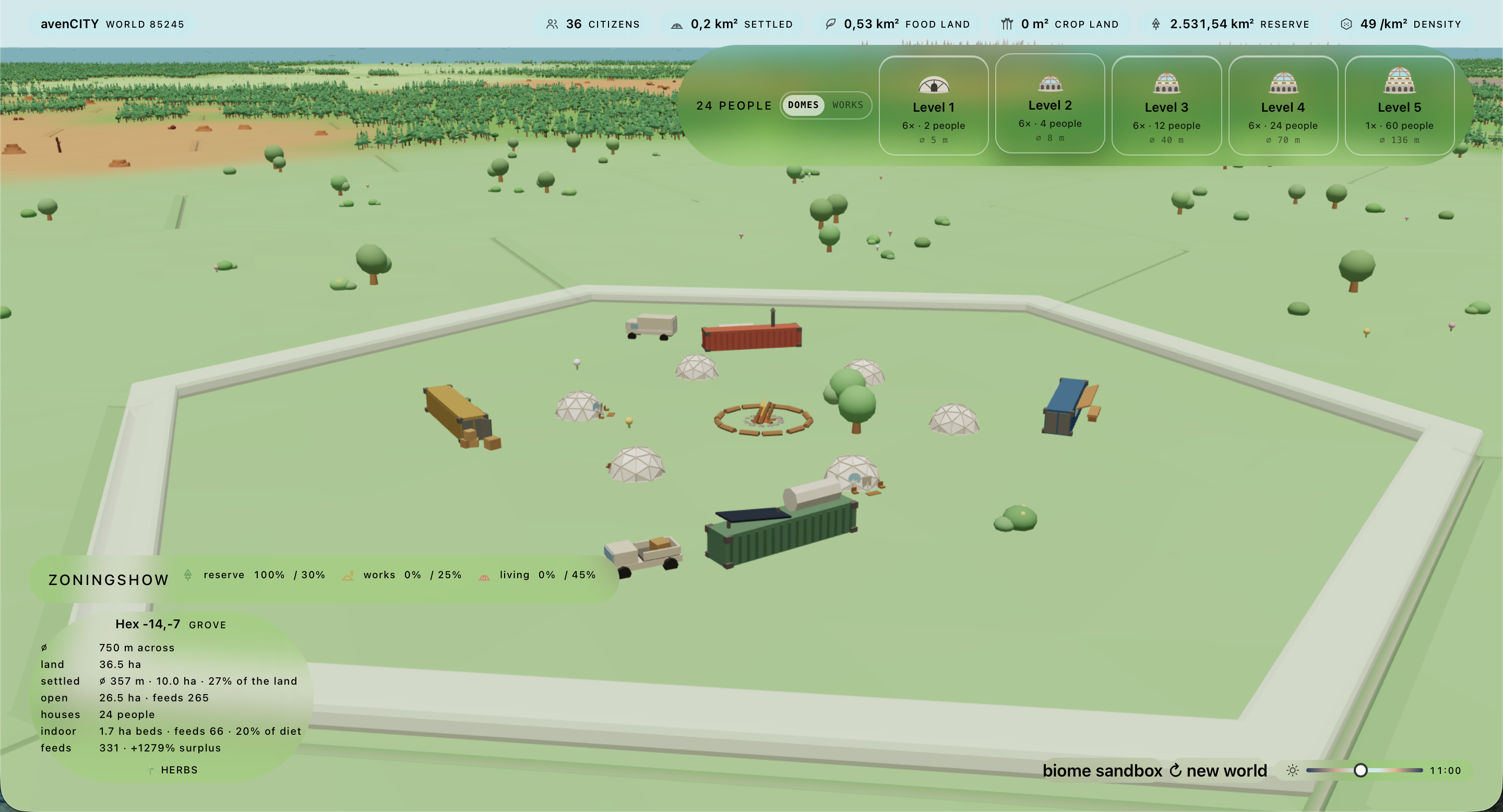
Eight metres across, four people per dome, 24 settlers. Same six positions, same ring, same land — 2.4 hectares of food forest and 1.2 of glass to match.
These are glamping domes: a floor, a stove, a proper bed, and a shell you can still take down in a day. Comfortable enough to get through a winter, light enough that the settlement has not committed to anything yet.
That is the whole purpose of the first two levels. Nothing permanent goes into the ground until the people are sure they want to stay, and the trees planted in year one are further along than the buildings.
Level 3 — the first permanent domes
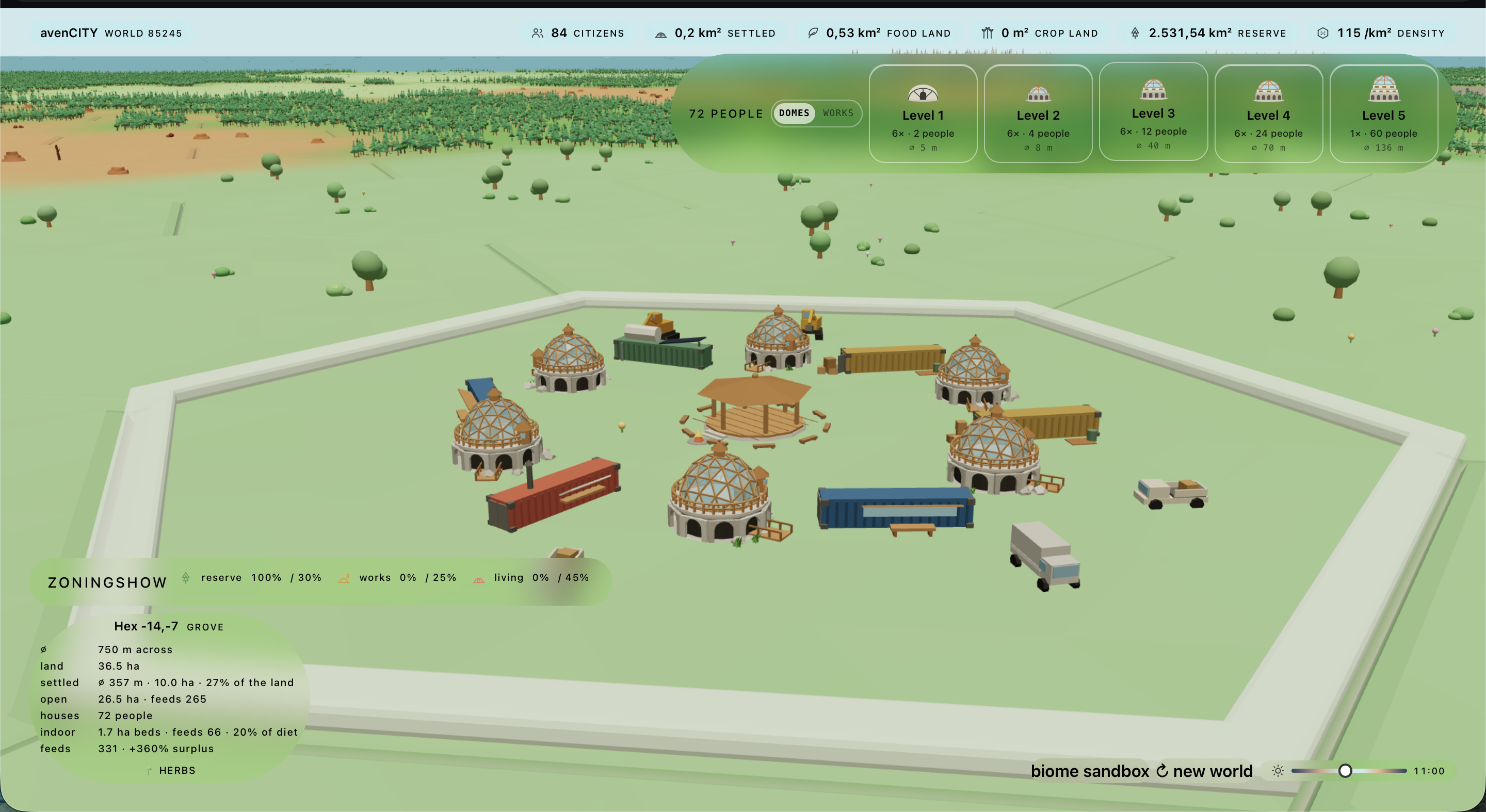
Forty metres across, twelve people to a dome, six domes: 72 settlers, 7.2 hectares of food forest, 3.6 hectares under glass.
The jump from 8 m to 40 m is where the settlement stops being packable. Arched stone bases, a timber and glass shell, workshops and benches spilling out between them — and in the middle, a roofed commons where the fire ring used to be.
These six are built to outlive everyone who raised them, and they stay standing through every level that follows.
The commons keeps its position through every level after this. What grows around it changes; the centre does not move.
Level 4 — 216 people, the size it was built for
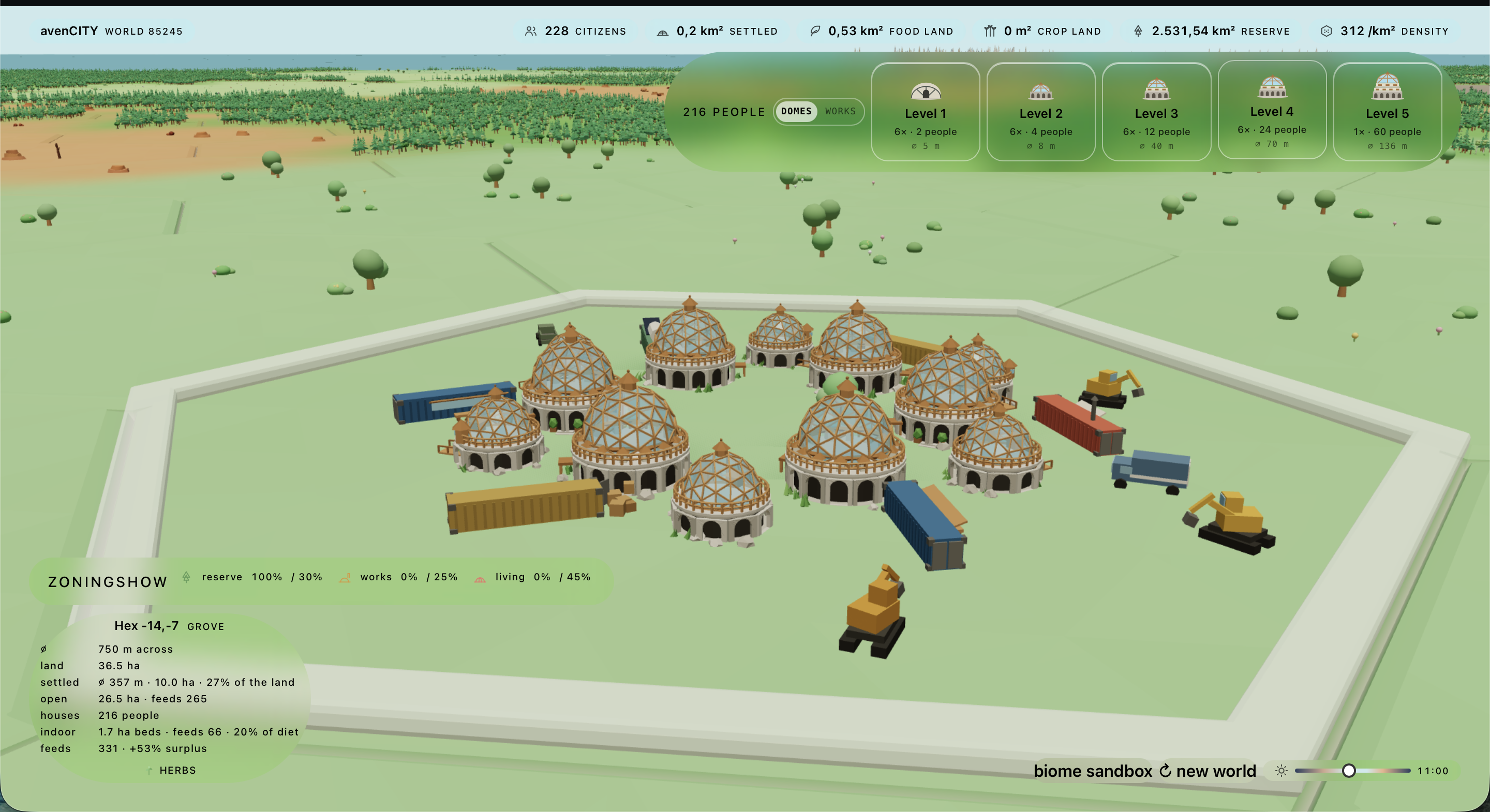
This is the first level that adds instead of replacing. Six new domes go up at 70 metres, 24 people each, beside the six 40 m domes that stay exactly where they are.
Six plus six: twelve domes, 144 settlers in the new ring and 72 in the old one. 216 — the number the hex was sized for.
Their green is fully planted now: 21.6 hectares of food forest outside, 10.8 hectares of beds under glass. Every settler still has their 1,500 m², and the land has nothing left to give.
This is the size where a settlement becomes socially real: enough people for a school run, a clinic, three workshops and a proper argument — and few enough that the commons still fits everybody.
Level 5 — the centre, where nobody lives
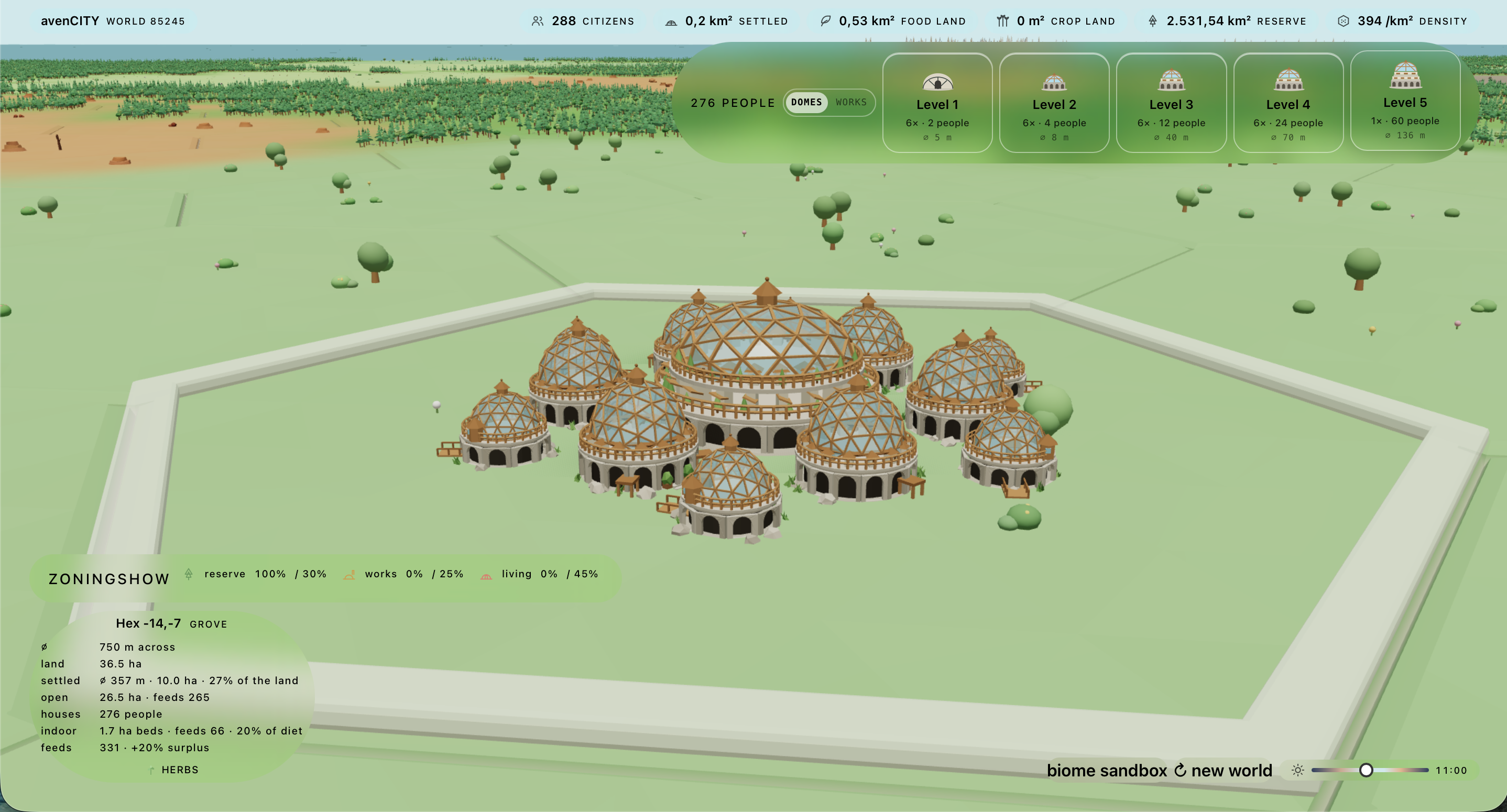
One dome, 136 metres across, at the heart of the ring. Nobody lives in it.
It is the only building on the hex that is not housing: the shared kitchen and hall, the solar and heat plant, the battery bank that carries the settlement through the night, and the compute that runs it all — the AI watching water, power, harvest and repair, in the same room where people eat.
Level 5 adds no settlers. It adds the backbone, and it takes the ground the fire ring has been holding since the first week.
Power, intelligence and commons in one structure, in the middle, owned by everyone living around it. Nothing essential sits off-site or in someone else's hands.
That is what closes the loop. Food from the ground it stands on, power and storage from its own roof, decisions and repair from its own people.
After Level 5 — the settlement builds its own machines
A settlement that feeds and powers itself but cannot fix its own tractor is still on a leash.
Every level so far was built with machines that came in on a truck: the excavator moving earth for the swales, the loader placing the dome bases, the tractor that does everything else on 41 hectares. Rent them, and the settlement works to someone else's schedule. Buy them, and it owns a black box that only a dealer can open.
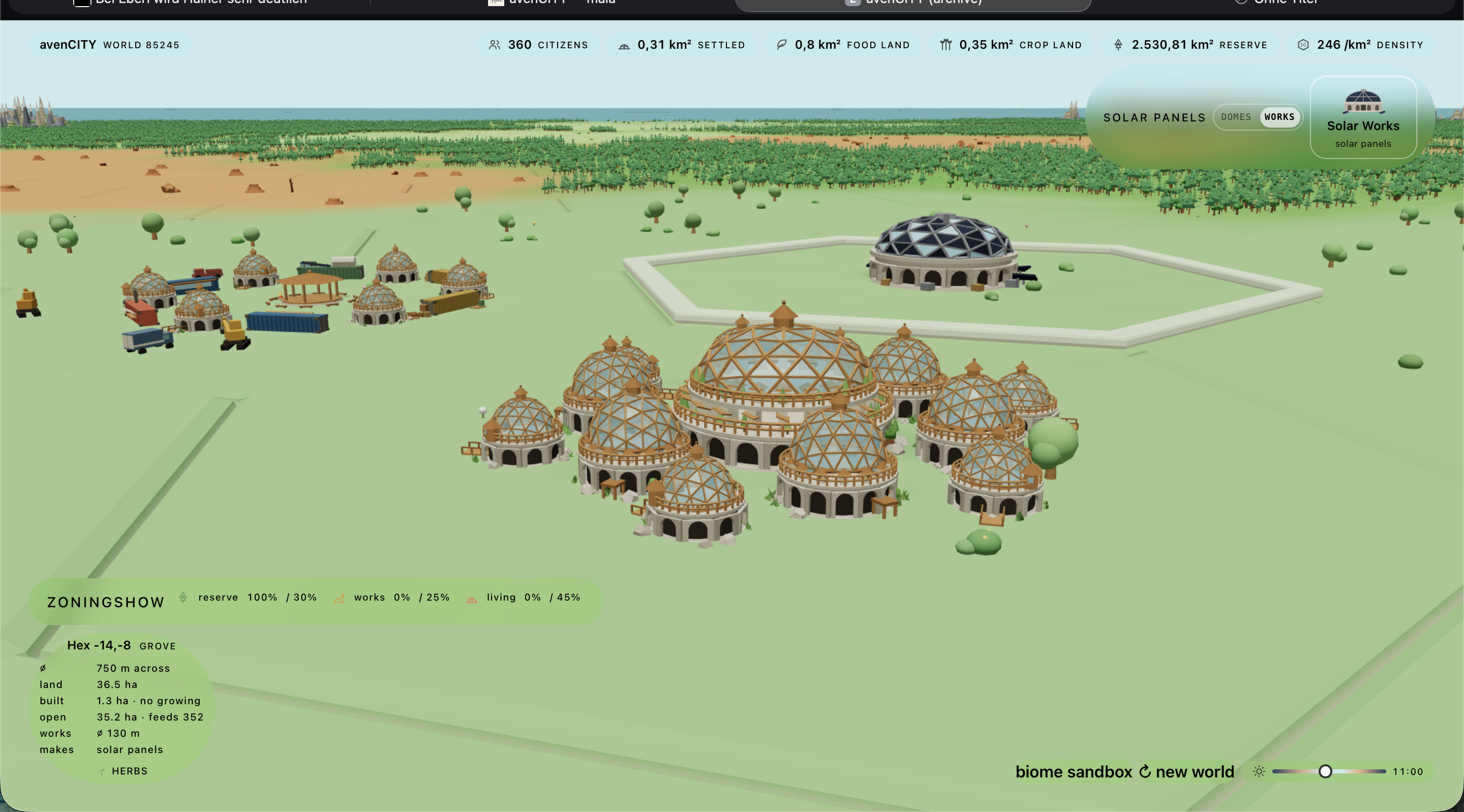
The last step is a works, on the hex next door, and the first thing it makes is the tractor.
One machine, to begin with: LifeTrac, the open-source tractor from Open Source Ecology, documented step by step and now in its sixth version. Bolted together from standard steel and hydraulic parts, with a detachable power unit and a frame built to be taken apart by whoever is standing next to it.
It comes out of the Global Village Construction Set — fifty machines whose designs are published for anyone to build — and the rest of that set is for later levels of the works. The first factory makes tractors.
Open source is not the ideology here, it is the maintenance strategy. A machine whose drawings you hold is a machine you can repair in your own workshop, in the same building where you learned to build it.
The works dome is 130 metres across and belongs to the settlement — theirs to own, staff, maintain and profit from. The other 40 hectares of that hex keep growing food, because a factory hex is still land.
One tractor runs the swales, the beds, the timber and the earthworks of a hex this size. The second one built here goes to the next settlement, and the drawings go with it — which is how a hex that can build machines turns into a grid that can build hexes.
Now the unit is complete: 216 people who house, feed and power themselves, and who make the machines the rest of the grid needs — with every hectare of it inside a boundary they can walk.
A city is not a plan drawn above the settlements. It is what happens when enough of them can stand alone — and then choose to trade.
One tent to a factory in five steps, on ground that never had to be extended. We are running it at 60 frames per second first, where a wrong ceiling costs an afternoon.
Then we pour the first real foundation.
Walk the island yourself. The world in these screenshots is running live — same hex grid, same dome levels, same zoning. Tap a hex, shift-drag to span, and build the settlement up level by level.